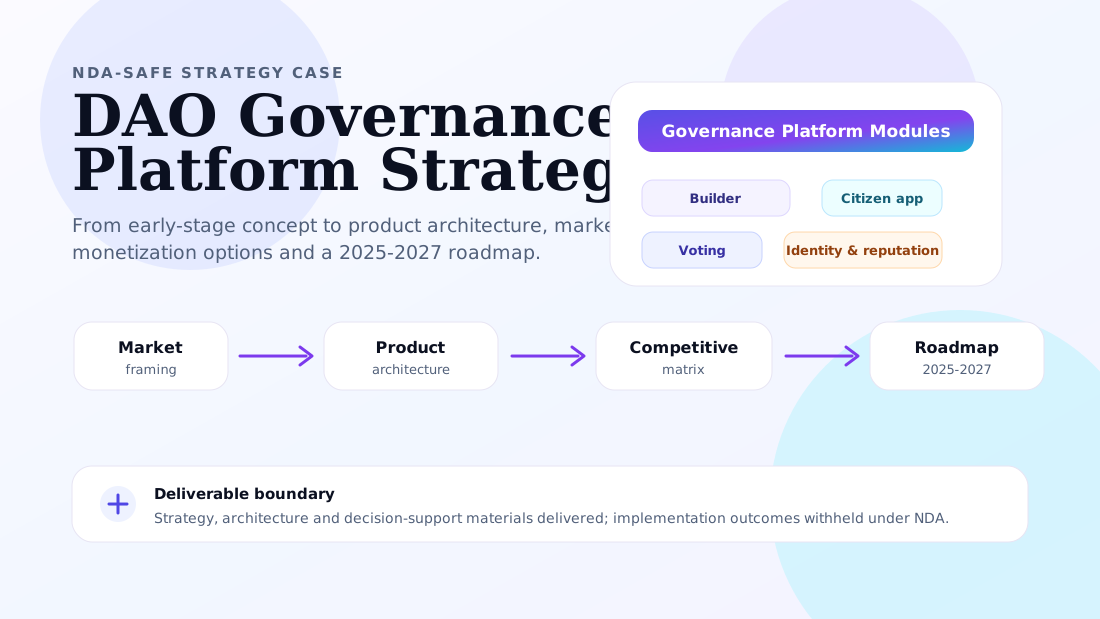
Context
The engagement focused on a DAO governance platform concept at the intersection of blockchain infrastructure, digital democracy, network-state thinking and public-sector digital transformation. The underlying product idea was ambitious: support transparent, structured and accountable decision-making for communities, organizations and potentially larger civic systems.
The challenge with concepts like this is not a lack of ambition. It is usually the opposite: the vision can become too broad to manage. The work was therefore not to "market crypto" or write a generic Web3 story. It was to convert a wide governance concept into a strategy that a client team could reason about, prioritize and hand over for further execution.
The core challenge
The project had to answer several practical questions before implementation could responsibly move forward. Who is the platform for? Which modules should come first? Which competitors are real substitutes and which are only adjacent references? What is the monetization logic? Where does DAO tooling end and governance infrastructure begin? Which risks matter most: regulation, adoption, architecture, security, or market trust?
Without this structure, the concept risked becoming a collection of attractive product ideas. The strategic work created a decision framework around the concept: market role, product scope, priority modules, competitive differentiation and scenario planning.
My role
My role was strategic advisory and product structuring. I developed the analytical base and strategy package: mission and vision framing, product portfolio logic, market positioning, competitor grouping, client segmentation, monetization options and a 2025-2027 strategic roadmap. Implementation was outside the scope of my engagement and was handled separately by other parties.
Strategic method
The work combined classic strategic-management logic with the specifics of Web3 governance. The analytical structure was closer to a full strategy-school assignment than to a startup pitch deck: external environment, industry structure, internal capabilities, competitive advantage, scenarios, implementation logic and KPI translation were treated as connected layers of one decision system.
The methodological base followed a Harvard Business School / Porterian strategy tradition in practical terms: start with market structure and sources of advantage, define a defensible position, translate that position into product and operating choices, then convert choices into a roadmap that can be reviewed through measurable indicators.
- Strategy-school framing.Clarified the object of strategy, strategic problem, mission logic, intended market role and governance value proposition.
- Domain and environment.Reviewed DAO, blockchain governance, network-state, digital-government, civic-tech and public-sector transformation patterns.
- Competitive analysis.Grouped direct and adjacent alternatives across DAO tooling, govtech, voting infrastructure, virtual-city concepts and network-state projects.
- SWOT / PEST / SNW.Separated near external threats and opportunities, macro-environmental factors and internal strengths, neutral zones and weaknesses.
- Product architecture.Mapped the platform into modules, adoption stages, user-facing functions and later expansion layers instead of treating it as one monolith.
- Balanced Scorecard logic.Translated strategic priorities into a KPI layer across stakeholder value, user adoption, internal processes, learning and innovation.
- Scenario planning.Built conservative, baseline and intensive development scenarios for the 2025-2027 roadmap, with different assumptions about adoption and execution capacity.
Used to turn strengths, weaknesses, opportunities and threats into practical strategic plan options rather than a static checklist.
Structured political, economic, social and technological forces around regulation, public trust, blockchain adoption and institutional readiness.
Separated strong, neutral and weak internal zones so the roadmap could distinguish current capabilities from gaps requiring investment.
Used Balanced Scorecard logic to connect strategy with measurable indicators across stakeholders, users, processes and innovation capacity.
Product architecture
The product architecture separated the platform into a sequence of modules rather than treating it as one monolithic application. This made the strategy easier to prioritize and easier for a future implementation team to plan.
The strategic recommendation was to treat the first modules as the foundation of the governance infrastructure, then expand toward identity, reputation, dashboards, policy-support analytics, treasury/resource allocation and network/federation functionality.
Market and competitor logic
The competitive landscape was intentionally not reduced to "other DAO tools". The analysis separated competitors and references into several groups: DAO creation platforms, digital-government infrastructure, network-state concepts, virtual-city or community experiments, land/asset governance projects and voting/decision tools.
This mattered because the platform's intended market role was broader than basic DAO creation. The strategic question was whether it could occupy the space between civic governance, community operating systems and enterprise/public-sector decision infrastructure.
Weighted competitive matrix
13 success factors across differentiation, competencies and platform-level capabilitiesClient segments mapped
30 potential public-sector, civic, enterprise and regulated-organization use casesPlanning horizon
2025-2027 scenario roadmap prepared for phased strategic developmentClient segmentation
The work mapped potential customers beyond the obvious DAO audience. The segmentation included central and local government bodies, agencies responsible for digital transformation, election and registry functions, public funds, social-service agencies, utilities, regulators, cultural institutions, education and healthcare organizations, corporate governance teams and private communities with complex decision structures.
The practical value of this segmentation was prioritization. The platform could not credibly serve every segment at once; the strategy clarified which user groups were natural early adopters, which required regulatory maturity, and which belonged to later-stage enterprise or institutional expansion.
Monetization logic
The strategy explored multiple revenue paths without forcing the platform into a single premature model. The monetization set included subscription tiers, transaction and smart-contract fees, marketplace modules, premium support and consulting, corporate customization, analytics dashboards, grant funding, white-label deployments, token-based internal operations and paid legal/governance templates.
The key recommendation was to treat monetization as layered: a broad access layer to encourage adoption, paid administrative and governance capabilities for serious organizations, and enterprise/public-sector customization for larger clients.
Strategic deliverables
What the work shows
This was not an implementation case and should not be read as one. Its value is strategic: it shows how an abstract, technically complex Web3 governance concept can be turned into a concrete decision package for leadership and delivery teams.
The work demonstrates a pattern I use often: take a broad ambition, separate it into decision layers, identify the market and operating constraints, map the competitive reality, define the product architecture and give the client a roadmap that can be handed to an implementation team without losing strategic intent.