Context
AVEK developed and commercialized NORMEL, a voltage-normalization technology designed for facilities operating under unstable or excessive voltage conditions in low-voltage grids. The product delivered value across three pillars: equipment protection, extended asset life and reduced energy consumption.
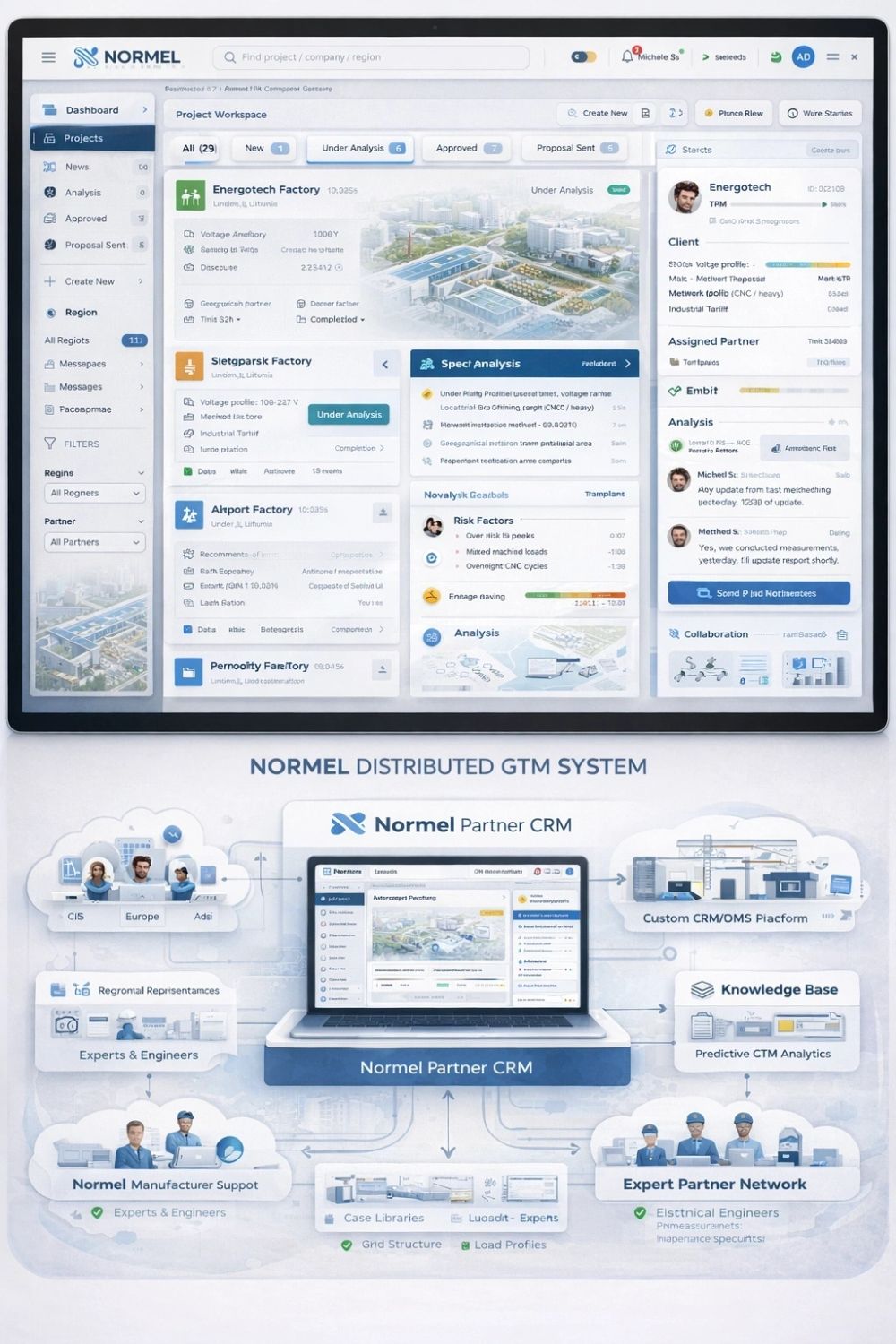
At the start of commercial scaling, the venture was effectively a startup: it had an engineering base, patents and a functional product, but lacked a scalable commercial framework. My role was to lead the architecture and rollout of an expert GTM system integrating an international representative network, a proprietary CRM/DMS platform, a shared knowledge base, and predictive analytics for more accurate market entry. The system supported the deployment of more than 5,000 devices, a 60+ partner network, and expansion across the CIS, Europe, Southeast Asia and North America.
Business context
The market required a highly targeted approach to client engagement. Commercially, the product relied on three primary value drivers: protection of equipment and technological processes; asset-life extension through more stable power supply; and energy savings through the reduction of excessive voltage. Most projects combined these drivers, but their relative weight varied significantly — in some cases protection was the dominant argument, in others the entry point was energy savings or lower depreciation. This required a precise, site-specific commercial narrative rather than a uniform pitch.
The core challenge
The primary barrier was the difficulty of scaling sales for a technically complex product. Remote selling was highly ineffective because it required deep analysis of the client's local grid, load structure and industrial processes. In parallel, on-site engineers often approached the solution with scepticism — they did not immediately understand the physical mechanism behind the effect and found the claimed result difficult to reconcile with the device's compact design.
Market heterogeneity added another layer: different tariff models, infrastructure conditions and industrial densities meant a universal narrative converted poorly. Other stabilization-class solutions existed, but they did not address the same combination of client problems or offer the same commercial logic of implementation. The system therefore had to preserve engineering credibility, accelerate presales, and convert local expertise into a shared commercial asset.
My role
I served as the architect of the core commercial operating model, coordinating the resources required for its design and launch. My contribution included designing the GTM model and partner-selection logic; architecting the CRM/DMS platform's operating logic; establishing interaction rules between representatives and the manufacturer; developing the knowledge-transfer model; enforcing territory management and channel-conflict resolution; and implementing predictive analytics to improve market-entry accuracy.
Solution architecture
We built an expert-led distributed network. The core principle was to build the model around technical specialists rather than generalist sales agents — recruiting electrical engineers, integrators, automation experts and adjacent specialists who already understood the pain points of unstable power supply and could speak the client's professional language. This created three immediate advantages: it lowered the trust barrier; it shortened onboarding time; and it improved the quality of initial site qualification.
Operating model — four building blocks
- 1. Expert representative network.Built around technically relevant partners already active in segments where power quality was a critical issue — resulting in a network of 60+ representatives across multiple regions.
- 2. Proprietary CRM / DMS as the management centre.A custom platform optimized for performance, internal coordination and data protection — the operational hub for data exchange (orders, technical site data, analytical requests), presales analysis (validating applicability before quoting), the knowledge base, cross-specialization collaboration, channel-conflict resolution via territory management, marketing/exhibition coordination, and analytics on partner activity and coverage gaps.
- 3. Knowledge as a commercial asset.For NORMEL, technical understanding was the primary driver of trust — once a client understood the physics, resistance dropped sharply. Making that knowledge scalable through documentation and case studies reduced dependence on individual sales experience and improved the quality of client meetings across the network.
- 4. Predictive GTM layer.Using CRM data and external sources, we built an analytical model in R and Python to transfer success patterns between regions. If a specific industrial profile or tariff model proved successful in one city, we could identify similar demand patterns in comparable cities — incorporating geotagged enterprise databases, grid infrastructure, generation structures and load profiles. This moved the business from reactive selling to proactive, precision targeting.
Representative outcomes
Revenue growth was sustained with step-growth periods driven by large-scale projects; footprint expanded across the CIS, Europe, Southeast Asia and North America.
Strategic impact
The work created a repeatable scaling mechanism for a complex industrial technology. It shifted the business away from dependence on centralized expertise and toward a managed distributed ecosystem where expertise is shared, market entry and lead quality are more predictable, channel conflict is minimized, and engineering credibility is maintained at scale.