Context
During the COVID period, Israel's largest FMCG retail chain faced a severe structural shock. Movement restrictions sharply reduced physical shopping, while a large share of FMCG customers — especially older and habit-driven buyers — were not yet comfortable buying groceries and household goods through a standard e-commerce interface.
This was not a typical digital growth initiative. It was an emergency transformation problem: demand still existed, but the habitual buying environment had collapsed.
Management set a clear task: restore sales to the highest achievable level as quickly as possible, moving as close as possible to the pre-COVID baseline. Within the program, my responsibility was to design the project system, define the solution architecture, assemble the required specialists around the problem, and prepare the transformation logic for approval and execution. The approved solution was a staged migration model aligned with customer psychology: first reduce behavioural resistance, then introduce personalization and predictive commerce once trust and usage patterns were established.
The core challenge
Across the broader restriction period, sales were down by approximately 60–65%, with sharper declines at the most extreme points. The core problem was deeper than traffic loss:
- customers still needed essential goods;
- many were not ready to shop in a purely digital way;
- standard catalogue navigation did not replicate how FMCG purchases are usually made.
In practice, the challenge was to move a traditionally offline audience into online purchasing quickly, at scale, and without forcing a sudden behavioural break.
My role & team
My role was to architect the transformation process within a wider cross-functional effort: define the solution logic, design the project structure, assemble the required resources, coordinate execution after approval, and report progress and outcomes to management. My contribution sat at the intersection of anti-crisis sales transformation, product strategy, CX design and digital commerce architecture.
The core working group included more than 10 people across psychology, UX/UI, analytics, CRM & marketing, and external ML support. As an emergency program focused on anti-crisis sales recovery, the market context required rapid launch, live observation and iterative refinement in production.
Stage 1 — a transitional interface: a behavioural bridge to online
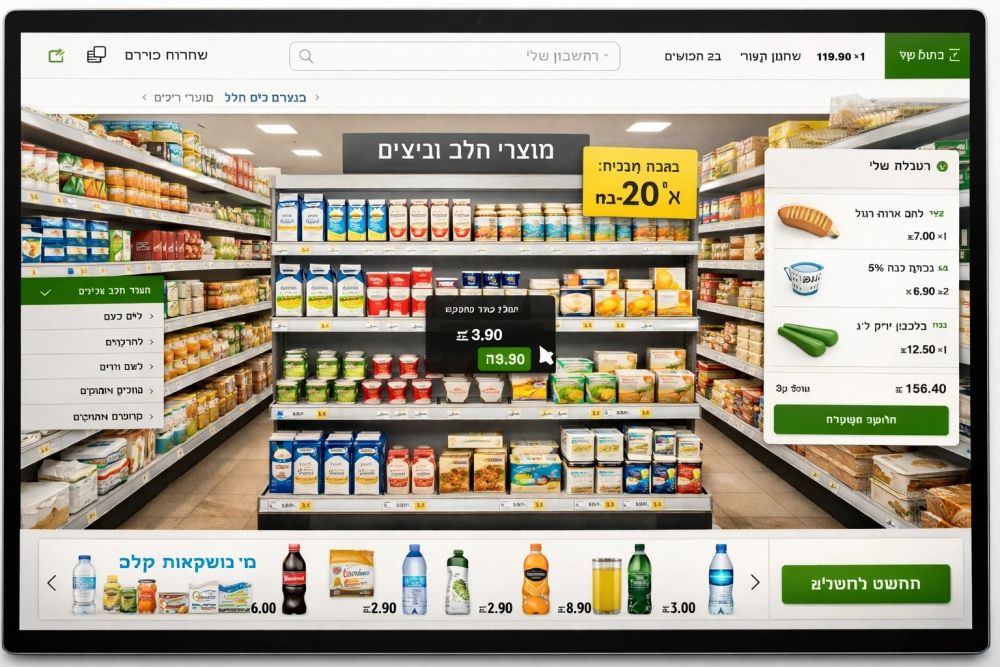
The first stage lasted 5 months. Rather than forcing customers directly into a standard e-commerce catalogue, we introduced a transitional interface designed to mimic the familiar logic of physical shopping — virtual shelf navigation inspired by real planogram principles. It was not a 3D store simulation, but it preserved enough of the visual and behavioural logic of in-store selection to feel intuitive. This was the key strategic choice.
The problem was not only digital readiness — it was behavioural mismatch. Many customers chose products by visual recognition, shelf context and habitual store movement; a standard catalogue stripped that away. The temporary interface restored it in digital form, creating a gradual transition:
- familiar visual product structure;
- lower cognitive friction;
- easier basket-building for routine purchases;
- reduced resistance among older, less digitally-adapted customer groups.
This was supported by detailed UX refinement based on customer feedback, shopping psychology, visual hierarchy and navigation patterns, and rolled out through multi-channel customer activation — social media; email and printable guidance; inserts in delivered orders; promotional messaging inside the digital storefront. Customers could choose which interface to use, and the system preserved their behaviour and preferences over time.
The importance of this stage was that it created a psychologically acceptable entry point into online buying for customers who otherwise might not have transitioned at all — a practical migration layer at a moment when competitors were slower to adapt.
Stage 2 — personalization & predictive commerce
Once users had crossed the behavioural barrier, the second stage shifted the model from transitional UX to personalized digital commerce. The company had a strong structural advantage: a high-coverage loyalty ecosystem — more than 80% of customers had identifiable purchase history linked to loyalty cards. That made it possible to move beyond catalogue shopping into behavioural prediction, identifying patterns such as:
- purchase intervals & seasonal shifts;
- price & promotion sensitivity;
- household consumption habits & likely family-composition changes;
- category relationships & adjacent needs.
Predictive basket. When a returning user entered the website or app, the system pre-filled a substantial part of the expected order based on prior behaviour and detected patterns. In many repeat sessions, customers retained roughly 82–94% of pre-filled basket items — only removing a small portion or adding a few missing products before checkout. That turned shopping from a manual search process into a partially automated approval flow.
Explainable recommendations. The system then moved beyond routine essentials to surface adjacent recommendations with clearer reasoning. Instead of acting like a black box, the product increasingly explained why a suggestion might be relevant — based on known purchasing behaviour, recurring patterns, category preferences or situational context. This reduced resistance to automation: customers weren't forced into a machine-led path; they were onboarded gradually, with visible logic and increasing trust.
Migration to the final model. The move from the temporary interface to the final personalized catalogue was gradual — for about 3 months users could still choose between interfaces while the company communicated the transition in advance and monitored reactions. The migration was highly successful: approximately 92% of users moved to the final personalized catalogue experience.
Measurable results
The ~60% post-restriction online share indicated durable behavioural change rather than temporary emergency usage; cross-category penetration rose after recommendations became more visible and better integrated into the purchase journey.
Why the sequence worked
The result came from matching the solution to the reality of the moment. The crisis was immediate; customer behaviour could not be changed through abstract digital optimization alone; the business needed a bridge rather than a forced jump. Personalization became materially more effective after behavioural migration had been solved first. The sequence mattered: recreate enough of the familiar shopping logic to reduce resistance → migrate users into digital behaviour without cultural shock → then use loyalty data and predictive logic to make online buying materially easier than offline.
Strategic impact
Beyond immediate sales recovery, the program helped establish online commerce as a structurally stronger business model inside the retail system. As digital demand stabilized, the company gained greater flexibility to optimize parts of its retail network and rely more on broader-assortment, more centralized formats where appropriate. Customer feedback also suggested a deeper shift in behaviour: for some users, weekly purchasing became a much lighter, more routine process — far less time on travel, search and repeated low-value decisions.