Context
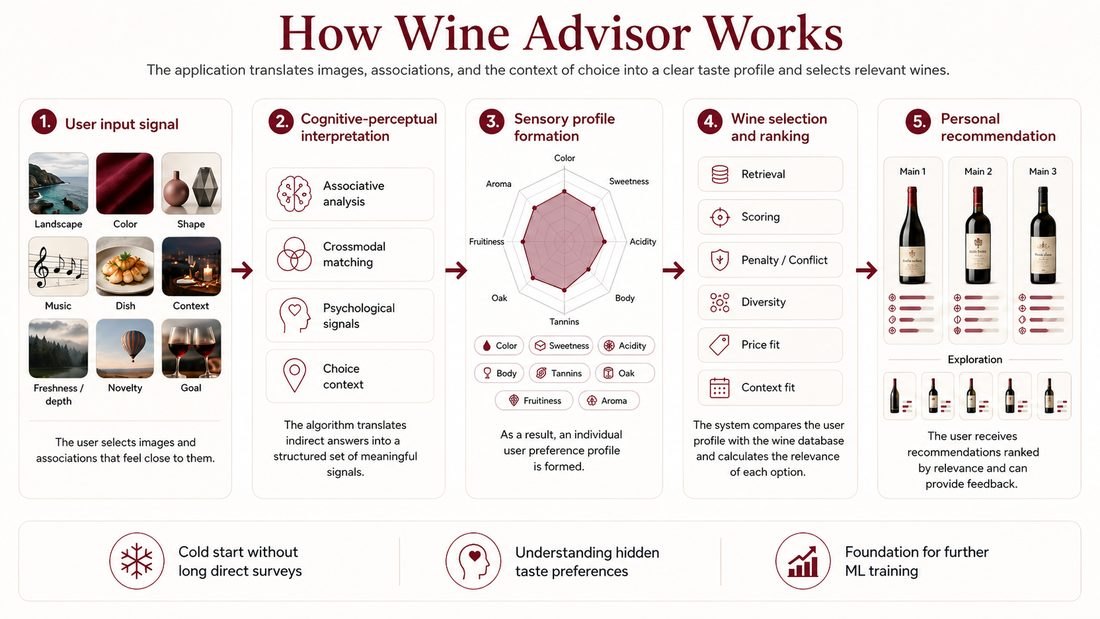
WineLab is built around a simple observation: most people cannot describe the wine they want in technical terms, but they can answer questions about images, colours, textures, moods, occasions and taste expectations. The system turns those associations into a measurable sensory profile and returns a small, confident set of bottles.
Read your senses. We'll pour the result.
Instead of asking users to choose between grape varieties, regions or expert descriptors, WineLab lets them express preference through perception. The product then translates those choices into wine language.
Business context
Wine retail has a structural conversion problem. The category is intimidating, the shelf is large, and the expert who could guide the choice does not scale to every online session or every physical retail moment.
Conventional recommendation systems often rely on collaborative filtering: purchase history, ratings, behavioural data and previous interactions. But for a new visitor, this data does not exist. That is the cold-start problem — and in wine, cold start is not an edge case. It is often the default state.
The opportunity was to personalize from the first interaction, without forcing users to rate bottles they have never tasted or describe themselves through vocabulary they do not own.
The core challenge
Three constraints had to hold at the same time. First, personalization had to work with zero prior user data. Second, the recommendation had to be explainable — a wine suggestion delivered as a black-box score is hard to trust and difficult to improve. Third, the system had to be verifiable: mapping associative answers to sensory logic can easily become vague unless the model can be tested, reviewed and corrected.
A fourth challenge was the catalogue itself. Wine data is often inconsistent, incomplete or unevenly described, so the dataset had to be treated as part of the recommendation architecture — not as a passive list of products.
Solution architecture
WineLab works as a three-stage pipeline: associative quiz → sensory profile → protected recommendation engine. The user completes a short crossmodal quiz, and each answer contributes to a profile across eight sensory axes — colour, sweetness, acidity, body, tannin, oak, fruitiness and aroma. The recommendation engine then compares this profile with the wine catalogue and returns a ranked set of recommendations.
The scoring logic stays server-side. The frontend visualizes the result, but does not expose or execute the recommendation engine itself.
Explainability
Explainability is treated as a product feature, not as an internal diagnostic layer. WineLab does not only show bottles — it shows why the system selected them. The user can see:
- their sensory radar;
- their sensory profile;
- dominant cognitive tags;
- recommendation cards with their match logic;
- a balance between close matches and controlled exploration.
This makes the recommendation readable. The user is not asked to trust a hidden score; they can understand the sensory path that produced the result.
Recommendation logic
The output is deliberately compact. WineLab produces six recommendations: three wines that closely match the user profile, and three exploratory additions that move slightly away from the core profile in a controlled way.
This avoids two common problems in recommendation systems — giving the user too many options, or returning six wines that are nearly identical. The goal is not only precision, but useful discovery.
Data foundation
The catalogue contains 7,954 wines. Each wine is treated as part of a structured recommendation dataset rather than a simple product row: the system uses sensory metadata, quality indicators and review signals to keep the recommendation layer reliable. This matters because a recommender can only be as good as the data it retrieves from.
Results
Figures describe the live system (Wine Logic Lab). The recommendation engine runs fully server-side and protected; the public interface visualizes its output without exposing the scoring logic.
Strategic impact
WineLab demonstrates a different approach to personalization. Instead of asking users to describe products directly, the system infers preference from how they perceive images, textures, colours, moods and contexts — which makes cold-start personalization possible from the first session.
The same pattern can generalize beyond wine to other categories where preference is subjective and difficult to express through standard filters: food, perfume, hospitality, lifestyle goods and cultural recommendations. WineLab turns vague sensory expectation into structured recommendation logic — helping users choose wine not only by what is written on the label, but by how the choice feels.