The decision problem
Market questions are rarely about a product alone. The relevant unit is product × audience × territory × time × price × context × competition. A useful answer must say which sources support it, when those sources were observed and which assumptions remain unknown. An attractive numerical forecast without that foundation is too easy to over-trust.
The inspectable research core
- Controlled collection.An owned crawler respects robots.txt, per-domain rate limits, budgets and resumable queues rather than relying on a third-party search wrapper.
- Versioned sources.Raw and normalized documents are stored with immutable versions, canonical URLs and multiple deduplication checks so a changed page does not silently rewrite the evidence base.
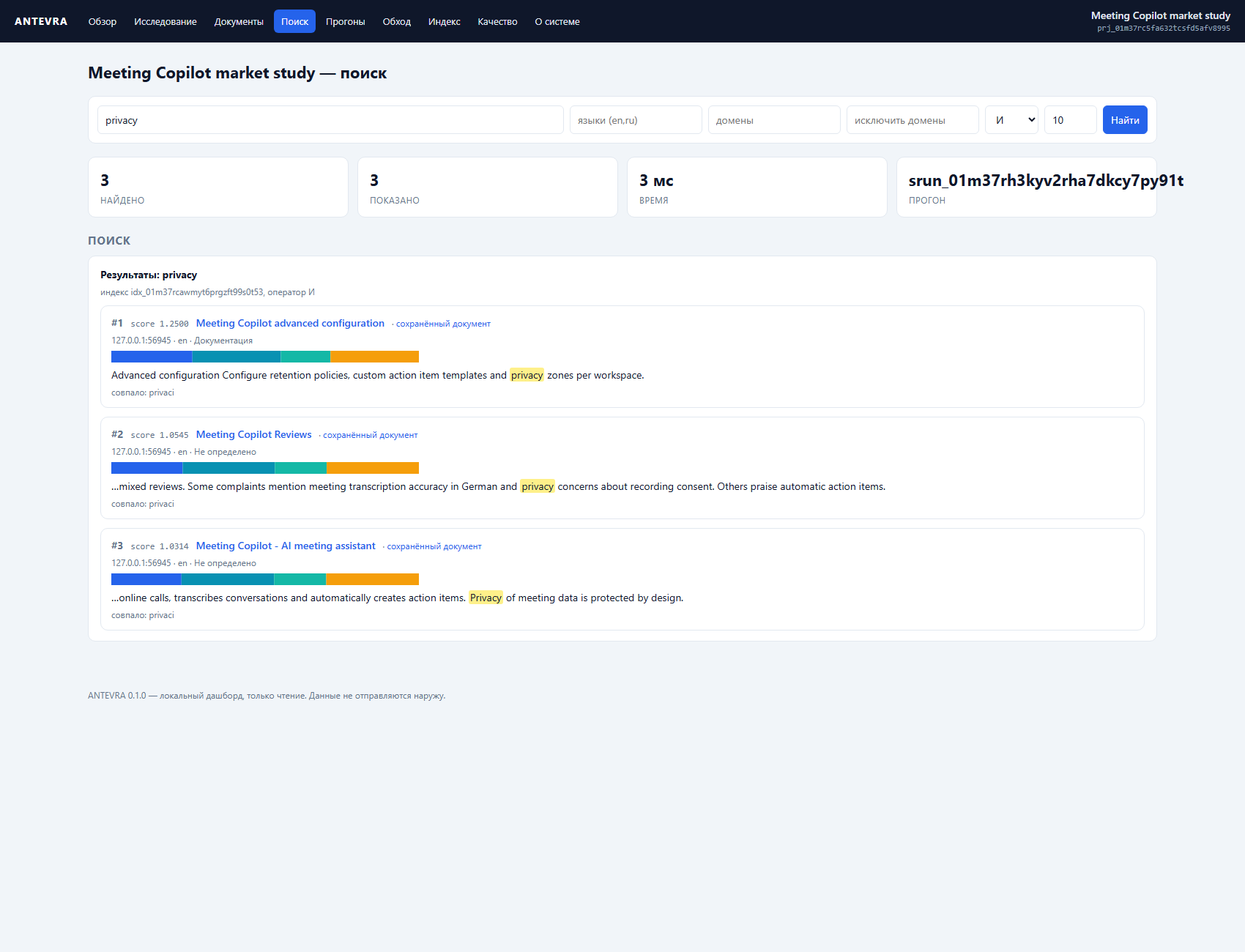
- Reproducible retrieval.An inverted index and query language support phrase, Boolean and field searches. BM25 ranking is adjusted by field, freshness, source quality and coverage, with persisted runs and score breakdowns.
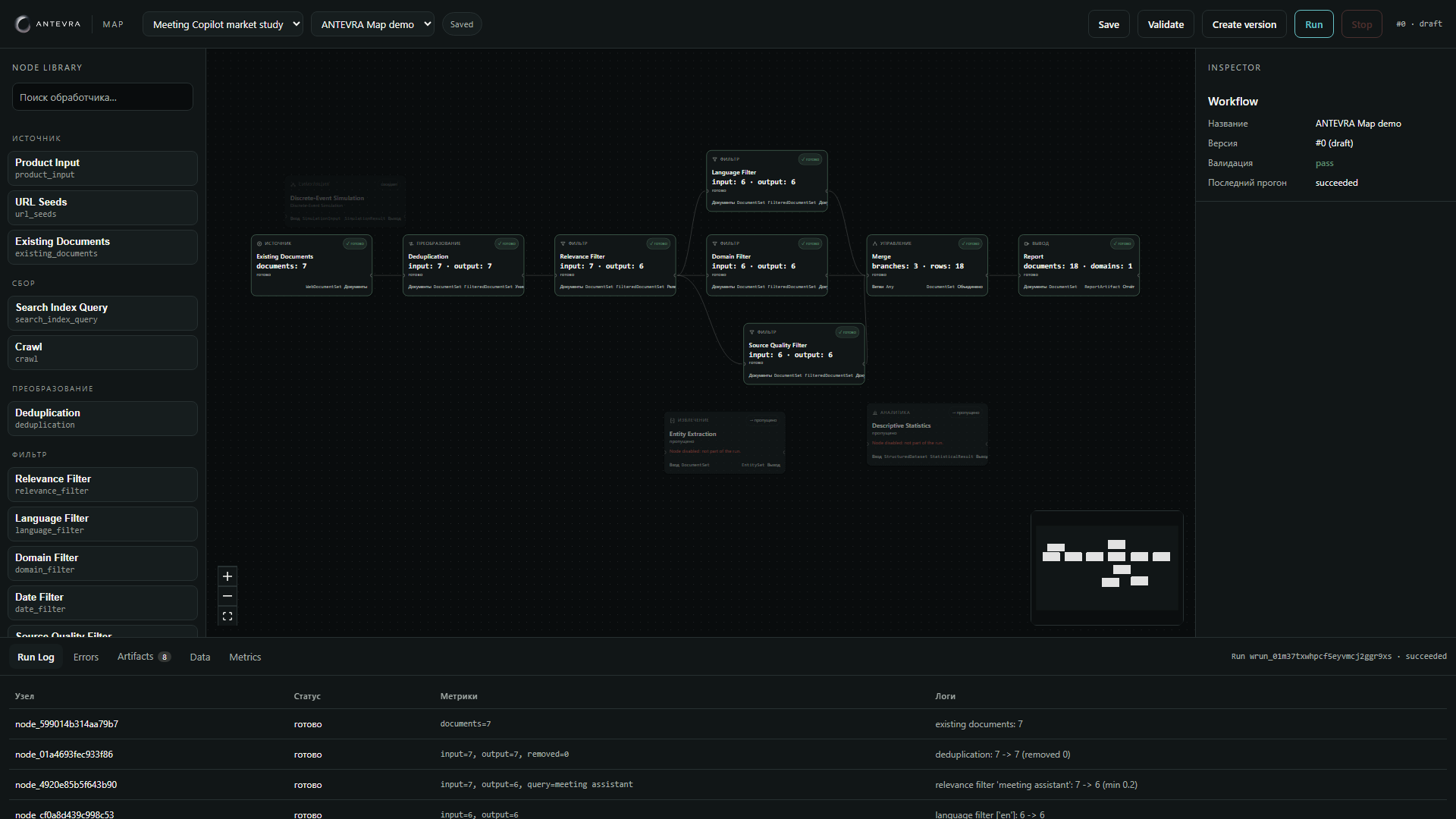
- Visual workflow.ANTEVRA Map can run typed research-processing steps, filters and merges, then produce report artifacts whose provenance leads back to source documents.
- Operator interface.A local dashboard makes collected data and searches inspectable. It is an operator console, not a public hosted SaaS product.
Simulation methodology
Simulation modelling is the umbrella method: represent a system over time, change assumptions and inspect how outcomes differ. ANTEVRA applies two complementary approaches within this method. The distinction matters because a market is both a set of actors making different choices and a sequence of events that unfolds under real constraints.
- Agent-based modelling.The agent-based approach represents market participants as distinct actors with their own states and decision rules. Interactions between them can produce patterns that an average-customer model would hide.
- Discrete-event simulation.The discrete-event approach follows consequential state changes in time. Order, waiting, delays and capacity constraints matter; a later decision can depend on what happened earlier.
- Combined scenario analysis.Reading actors and events together makes it possible to compare alternative market conditions while keeping simulated behaviour separate from observed evidence. The model and its parameters are not published on this site.
Methodological reference: AnyLogic's multimethod simulation overview. ANTEVRA is a separate system, not an AnyLogic implementation.
Research and modelling boundary
The public project material shows data acquisition, search and visual workflows. Simulation methods are implemented in a separate, non-public workstream, so this page explains their role without presenting model internals or numerical outputs as independently verified. Source observations, modelling assumptions and scenario results are different kinds of information and should remain clearly labelled.
My role
I defined the decision problem, analytical boundaries and product requirements, and guided the system's insistence on source lineage, explicit unknowns and staged verification. The software implementation is collaborative. No validated market forecast or measured commercial impact is claimed here.