
The question behind the platform
People can often describe the experience they want more easily than the technical attributes of a product. A conventional filter starts with the catalogue. Magnolia starts with the person and the situation: what matters now, what constraints apply and which signals are useful enough to ask for.
A short visual or associative interaction can help someone express a current preference. It is not, by itself, a psychological diagnosis. Earlier choices may add context when available, but the immediate request remains distinct from a person's longer-term history.
From research to a useful choice
- Define the decision.Describe the audience, the moment of choice, the available options and the practical constraints before designing an interaction.
- Design the signal.For each question or visual stimulus, specify its intended meaning and the alternative associations that could affect a response.
- Interpret in context.Combine several current-session responses into an explainable preference representation; treat past behaviour as an additional input, not a substitute for the present request.
- Model the offering.Connect preference signals with a domain-specific catalogue. Attributes, exclusions, availability and expert review have to be defined for each category.
- Explain and evaluate.Show why an option fits, distinguish preference from commercial constraints and measure the choice journey without turning inferred motives into observed facts.
The research layer
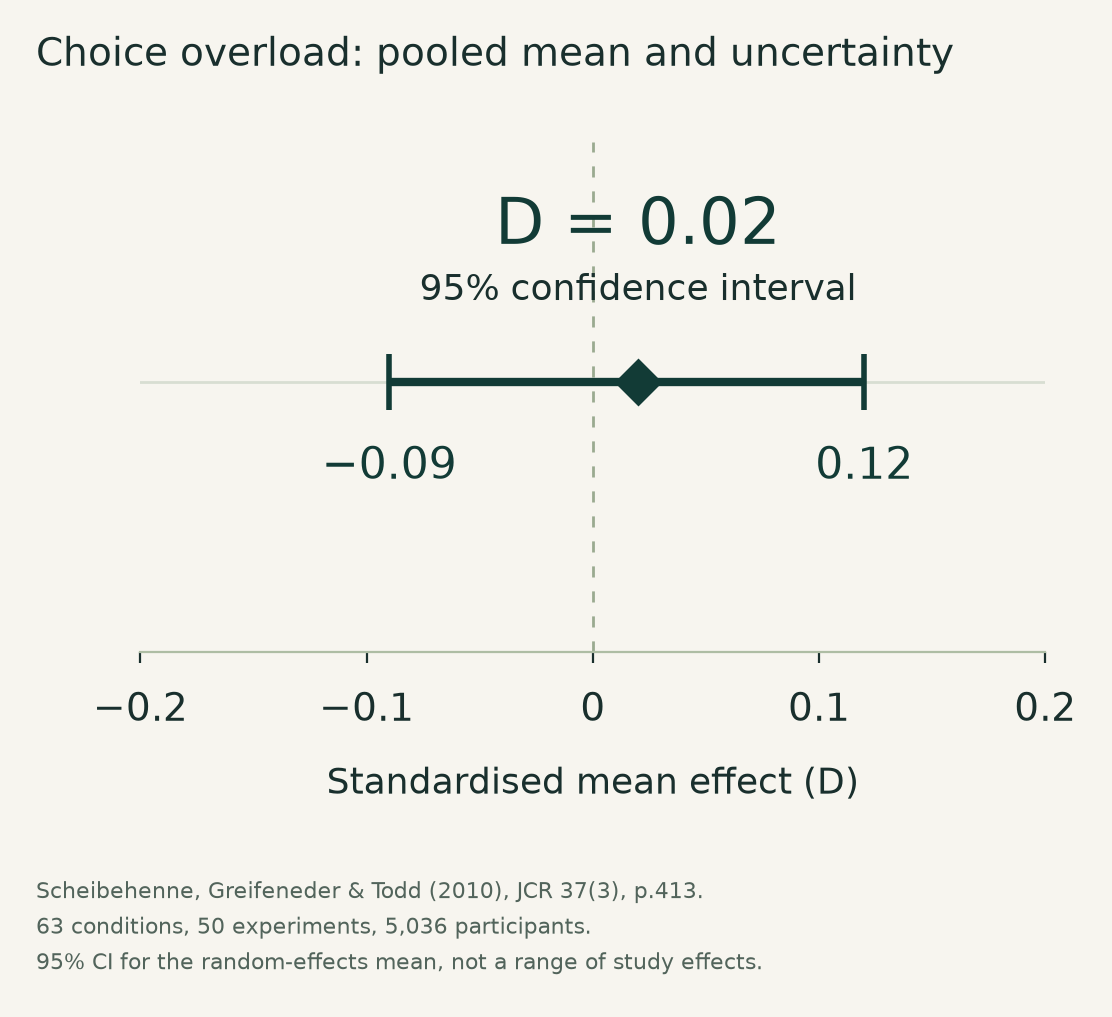
Magnolia's research materials connect consumer behaviour, perception, interaction design and recommendation engineering. One recurring question is how much choice a person needs: more options can improve discovery, but can also add work. The evidence is more nuanced than a universal rule that fewer options always convert better.
Attention is not the same as a decision
Another study in the research review compared displays of six and twenty-four jam flavours. The larger display drew more attention; among people who stopped, a smaller share bought from it. These measures have different denominators and cannot be collapsed into a simple conversion claim.
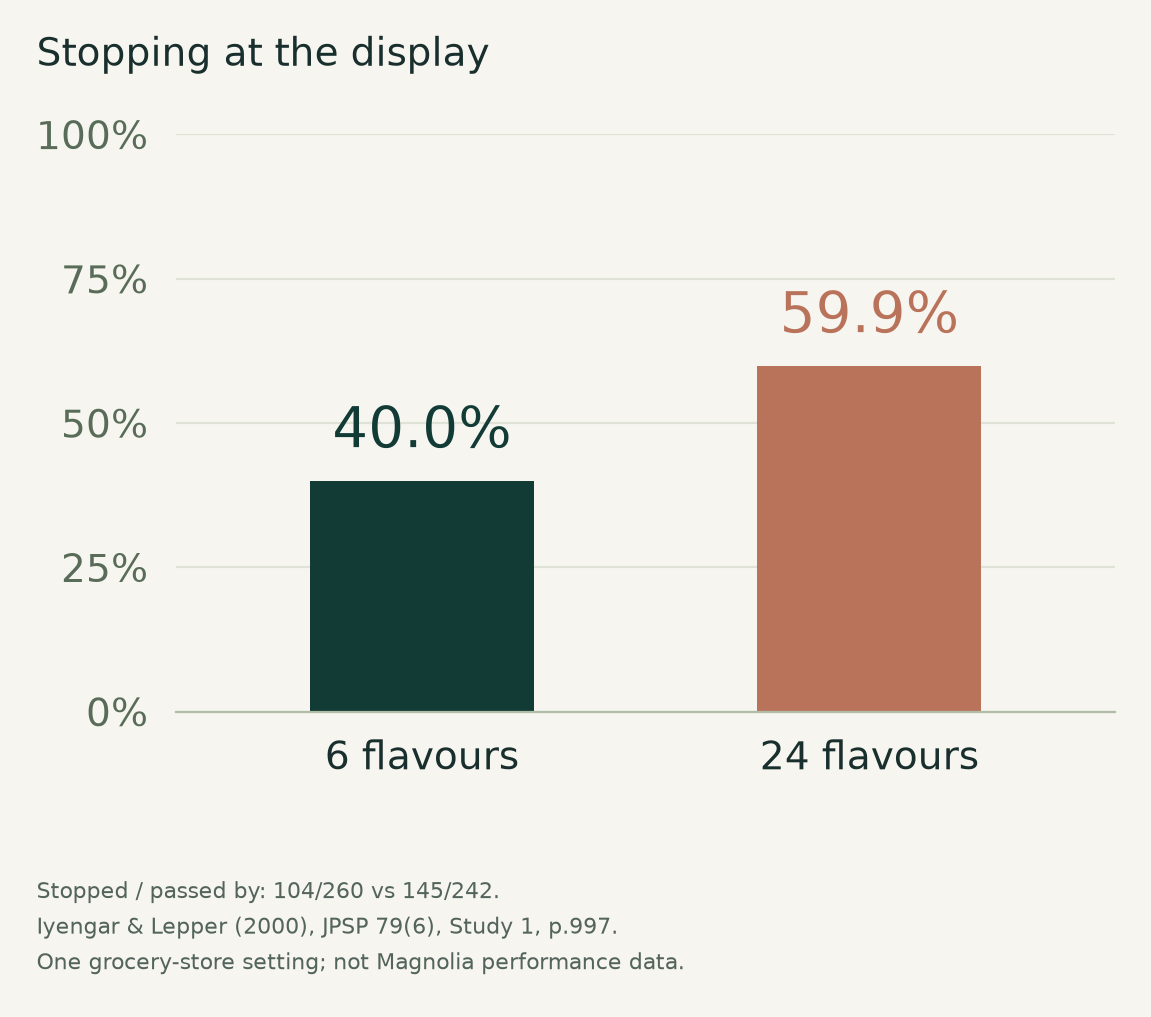
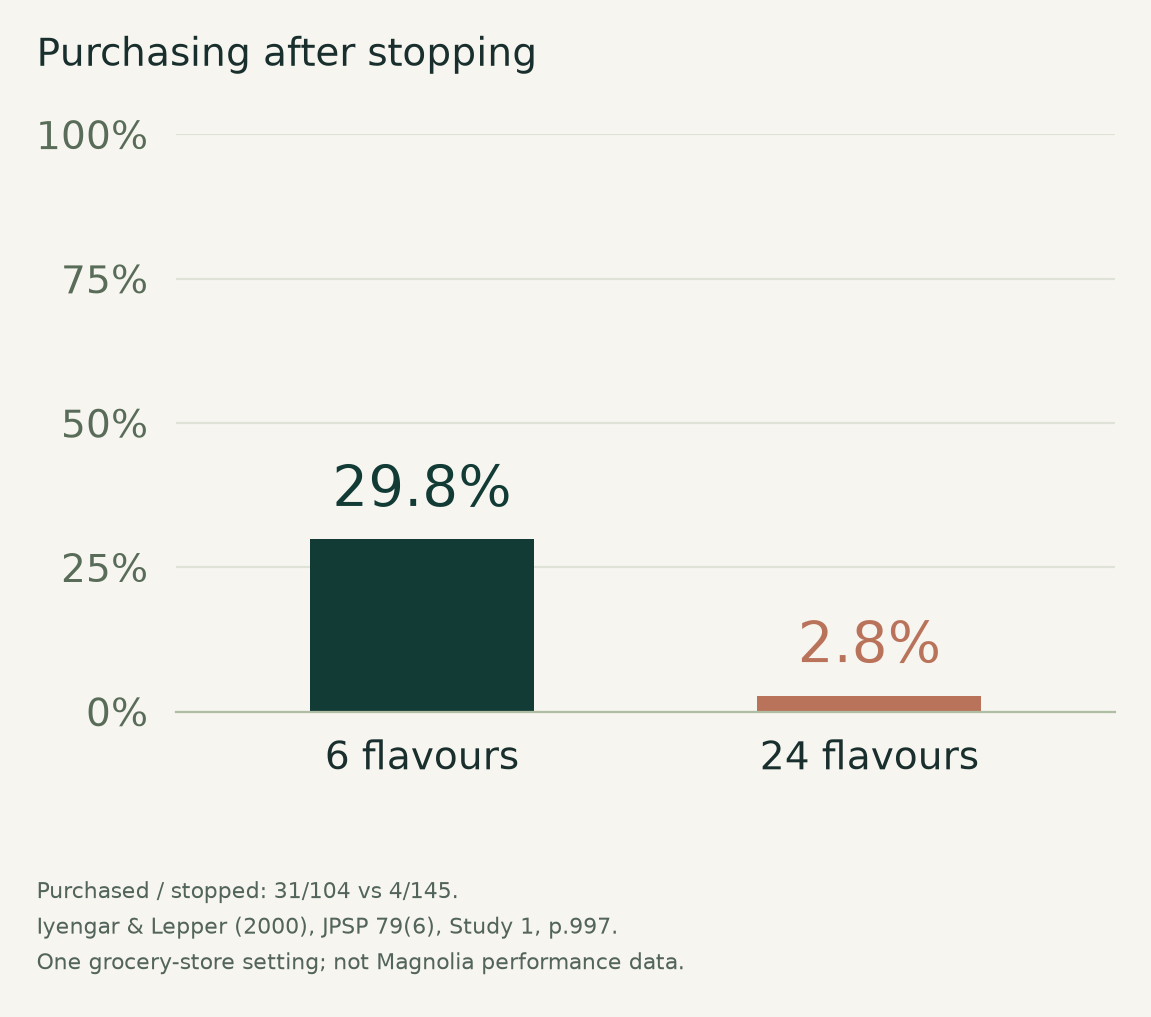
Source: Iyengar & Lepper (2000), Study 1. These charts summarise published external research used to frame Magnolia's questions; they are not Magnolia product outcomes.
Several domains, separate evidence
The program considers product, food, music, travel, activities and group decisions. They share a question about expressing preferences, but not a ready-made model. Each domain needs its own catalogue language, interaction, constraints and evaluation. A product demonstrated in one domain is not evidence that the others are deployed or equally mature.
My role
I shaped the product thesis and business framing: where guided choice could be useful, how research can inform an interaction, what the analytical layer should observe, and which claims need validation. I coordinate the questions across strategy, psychology, analytics and engineering. The software and research work are collaborative.
Current status
Magnolia has a distinct identity, website, research notes and product architecture. The broader multi-domain program remains in development, with each application requiring its own model, product work and validation.