Inside the workspace
One system, several working surfaces
Actual NORMEL web screens captured against an isolated local database. All people, companies, tasks and deal values shown here are fictional. The CRM module still displays Russian labels even with English selected; its localization remains open.
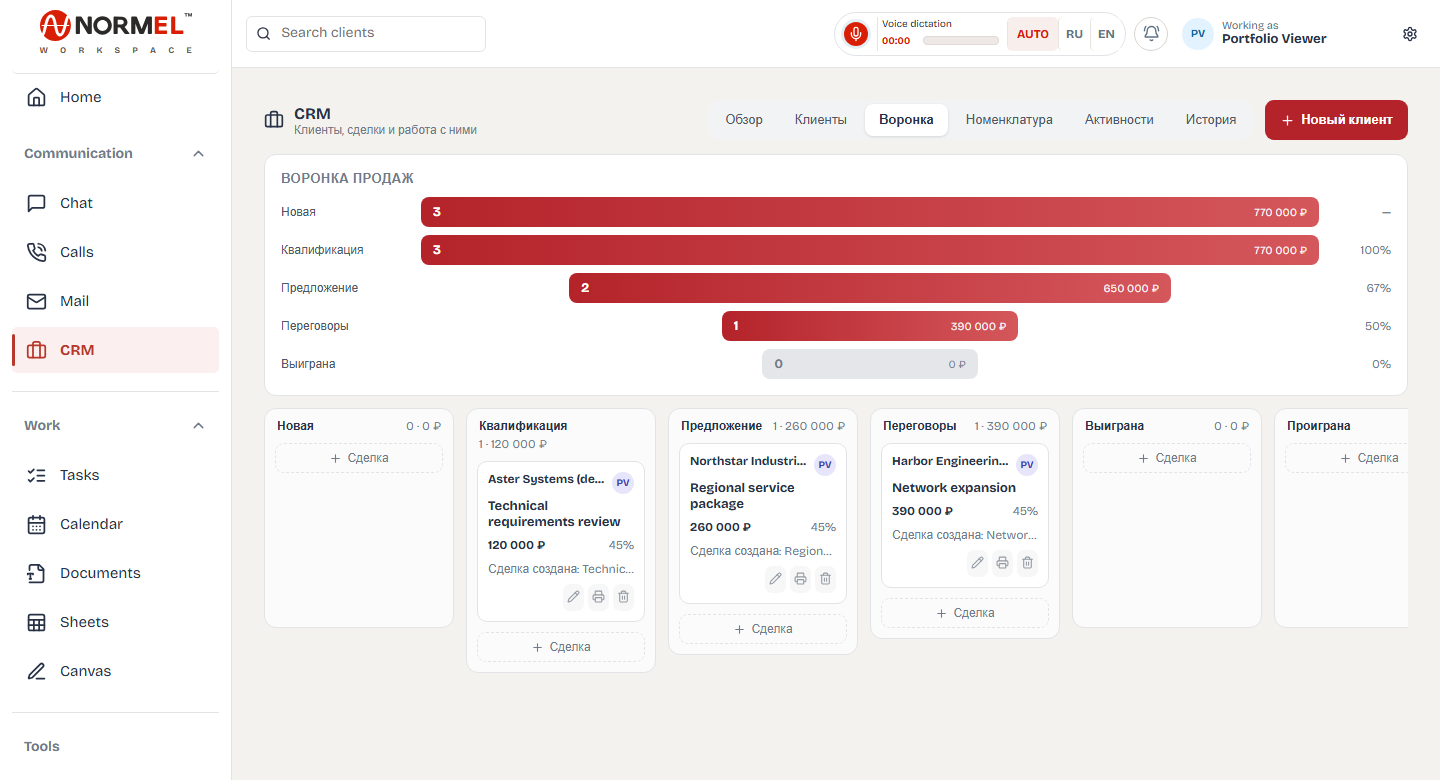
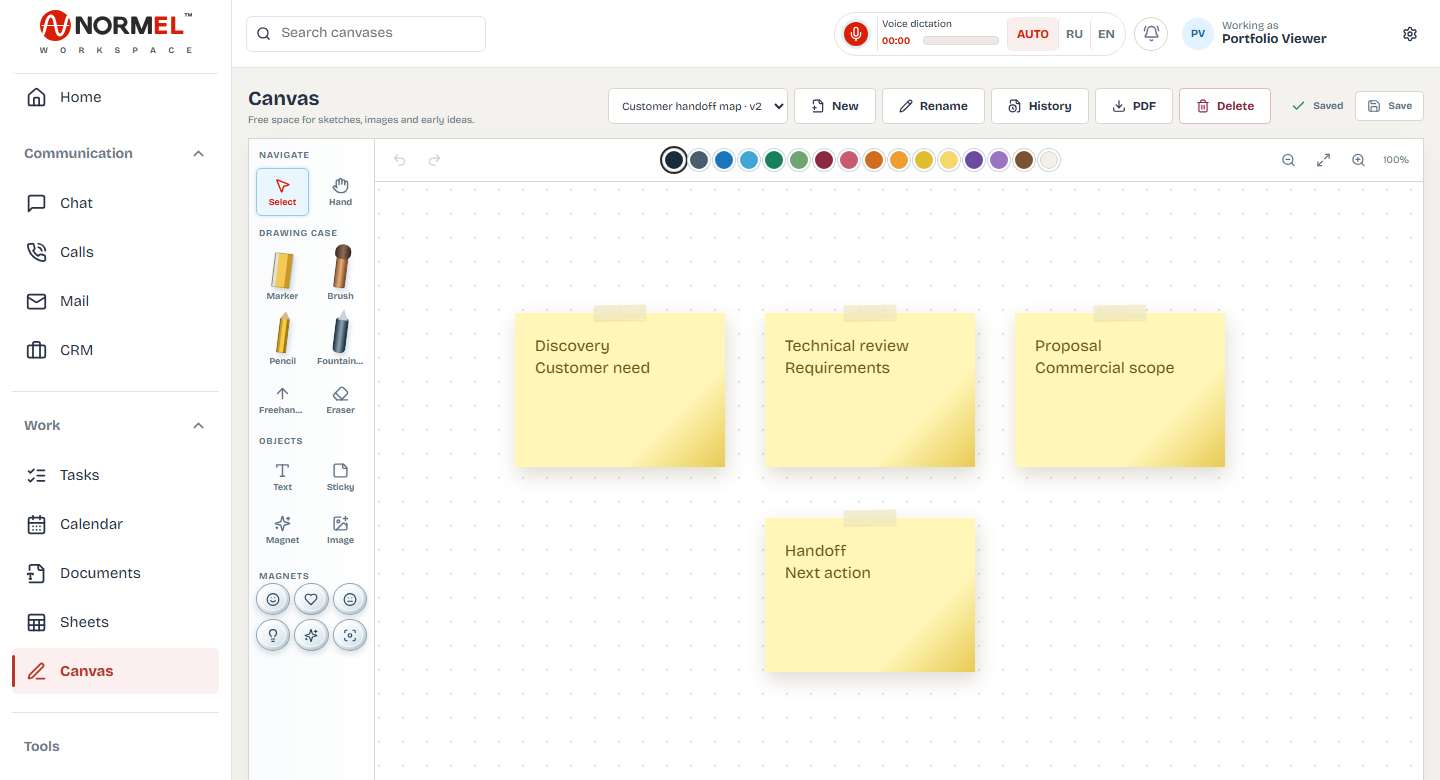
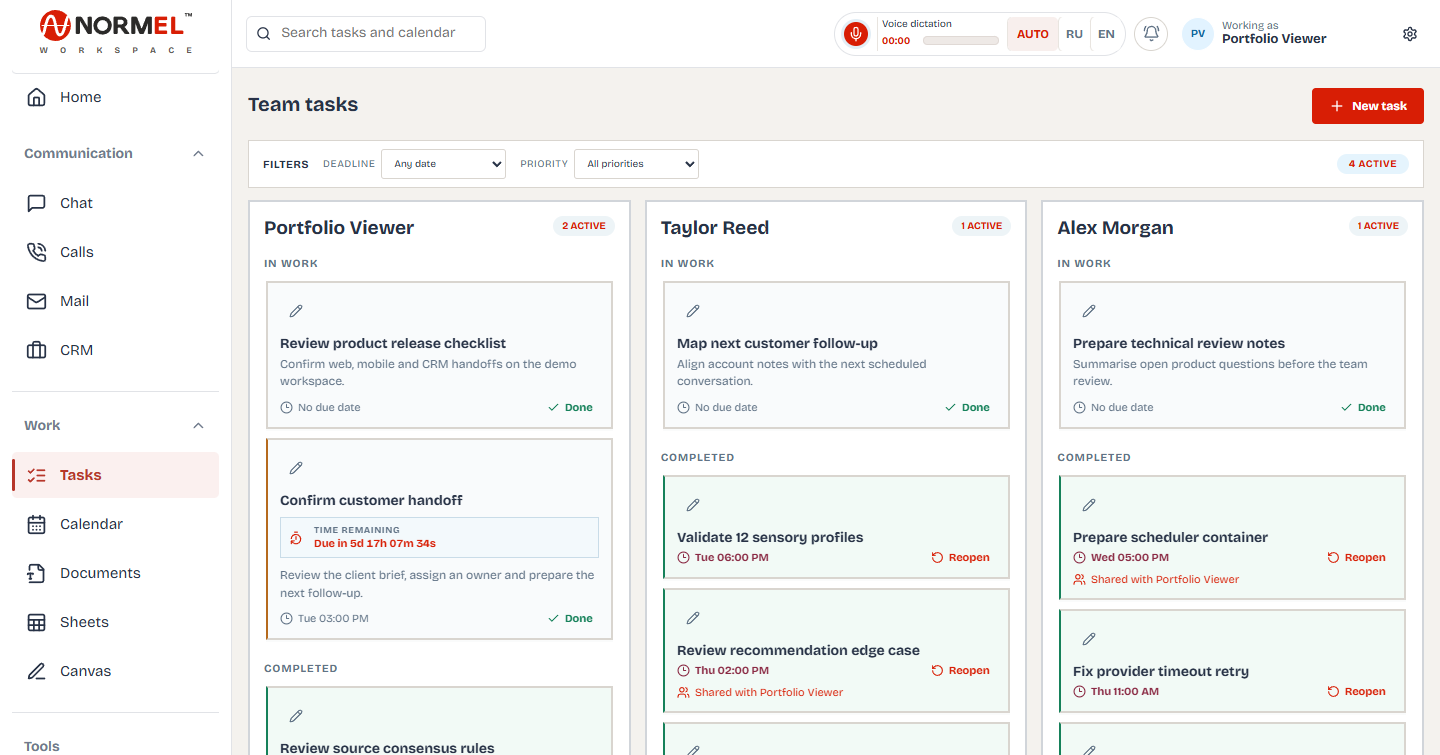
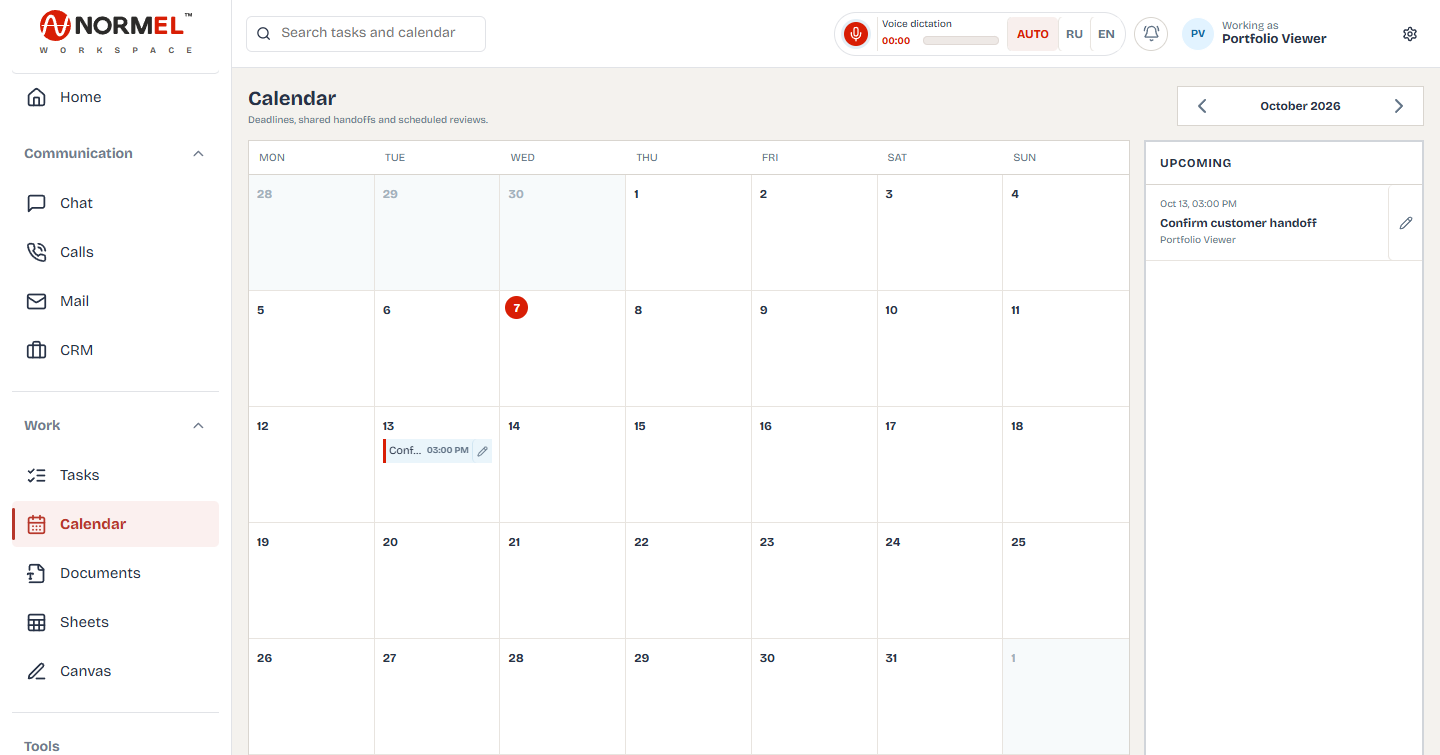
Web workspace, native Android client and a common service layer.
Why it exists
Industrial commercial work crosses teams, territories and specialisms. A customer conversation may become a deal, a technical question, a task, a document and a follow-up call. When each lives in a separate system, people lose context and cannot see what changed. NORMEL Workspace brings these activities into a shared, access-controlled environment.
Four connected areas
- Communication.Direct and team chat, voice messages, personal and group calls, presence and mail keep conversations connected to the work they generate.
- Commercial management.The CRM brings together clients, contacts, deals, pipeline stages, product catalogue, activities and change history. Ownership rules are enforced in the service layer, not only in the interface.
- Execution.A personal home feed surfaces new assignments, mentions, missed calls and other relevant changes. Tasks and calendar records carry deadlines and responsibilities into daily work.
- Knowledge and artefacts.Documents, spreadsheets, canvas, mind maps, shared files and a knowledge area give the team places to create, find and reuse its working material.
One system, different surfaces
The web product exposes the full workspace. The Android app is a native companion rather than a WebView or a second data store: it concentrates on chat, calls, files, mail and calendar, while specialised editors open in the web workspace. Both clients use the same server-owned records.
CRM, communication, coordination and editors
Identity, records, realtime events and notifications
Chat, calls, files, mail and calendar
The production web runtime uses Cloudflare Workers with D1-backed records and a realtime connection layer. The Android client uses Kotlin and Jetpack Compose, with local cache and retry for interrupted connectivity. These implementation choices serve continuity across devices; they are not a substitute for testing actual behaviour on devices and networks.
Product decisions
- Context before another tool.The home feed links a new event to its source, so an assigned deal, task, document mention or missed call can become an action rather than another isolated notification.
- Shared records, selective parity.The phone has native interactions where immediacy matters. It does not duplicate every web editor; file links return to the appropriate workspace surface.
- Traceable commercial work.CRM changes create history and activity records alongside the data mutation. Client and deal ownership has explicit rules, while the catalogue remains editable as prices change.
- Reliability as release work.Message delivery, call routing, offline recovery and cross-client state are checked through specific QA gates. A feature appearing in code is not treated as proof that every device scenario has passed.
My role
I shaped the product scope, operating logic and interaction requirements, and coordinated priorities across the web, service and Android workstreams. My contribution includes defining how commercial records, communications and daily execution fit together; reviewing release behaviour; and insisting on testable acceptance criteria for cross-device flows. The software implementation is collaborative, not a claim that I wrote every component alone.
Status and evidence
The authenticated web workspace and signed Android companion have been released and continue to evolve. The product has concrete CRM, communication and work-management surfaces; this page does not claim adoption figures, revenue impact or universal call reliability. Cross-device and physical-device checks remain release-specific.